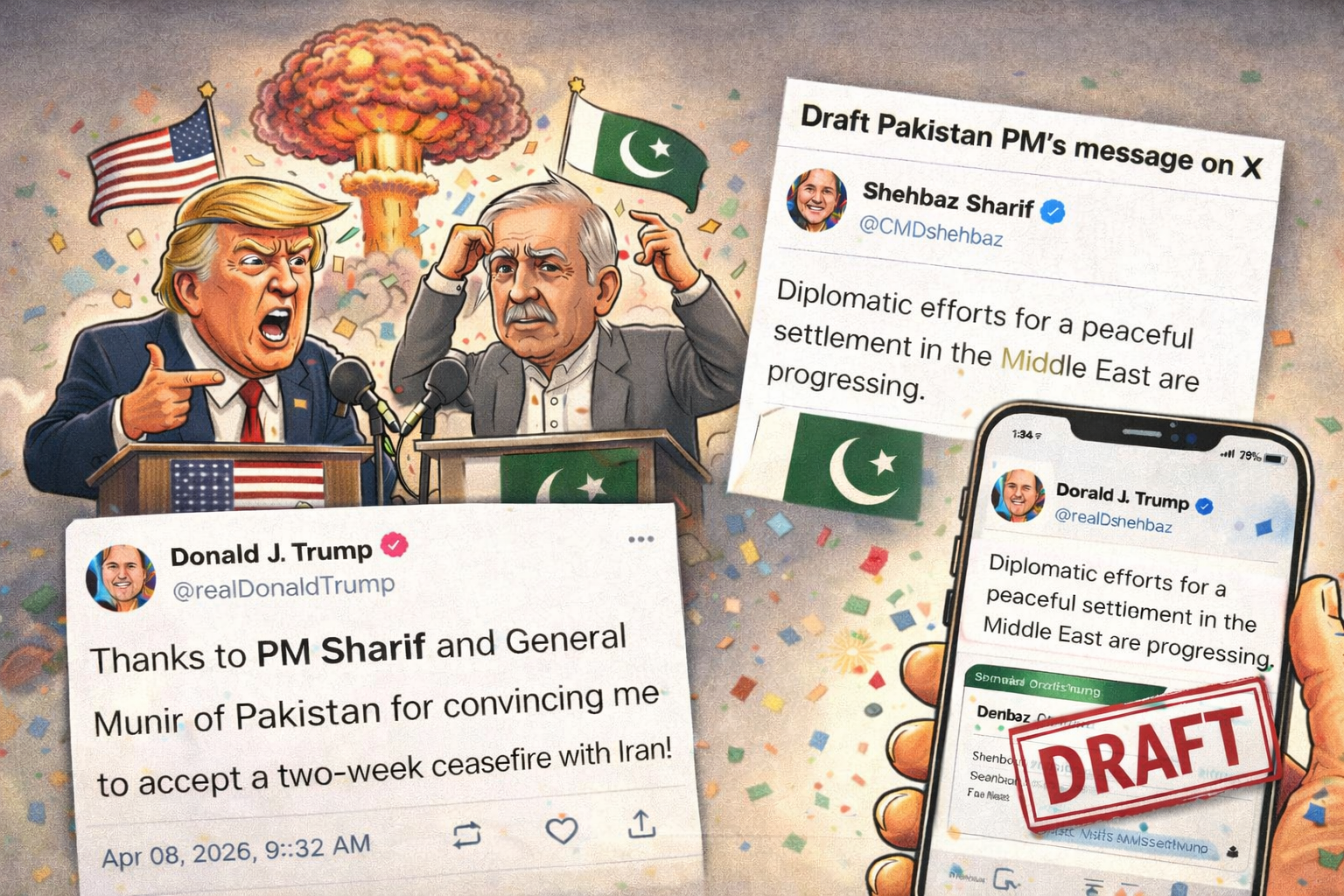
Draft Tweet Diplomacy: How Pakistan’s Peace Play Exposed a Manufactured Exit
The world is relieved that a ceasefire has finally been announced. There was something deeply unsettling, almost chilling, about hearing the most powerful man on earth, the President of the United States, talk so casually about ending a civilization, about wiping out a nation, about language that bordered on genocide. And all of this against the backdrop of a ticking clock, a deadline that kept creeping closer, louder, heavier.
And yet, the Iranians seemed completely unfazed. If anything, they responded with a kind of defiance that was almost surreal. Across social media, official handles, embassies, consulates, they responded not with fear, but with memes, jokes, sarcasm. They treated the threats not as credible ultimatums, but as the outbursts of a man-child, a pampered bully trying to pick a fight with someone far more seasoned, far more grounded.
The President’s tweets were not just unbecoming of someone in that office, they revealed something deeper, a growing frustration, an irritation that he could not break through, could not force the Iranians to bend, to concede. That irritation spilled over into language that was vulgar, inappropriate, and frankly alarming when directed at an entire civilization. It was the impatience of a man-child with immense power, but very little restraint.
And then, just as the deadline loomed large, there was a sudden shift.
Out of nowhere, global media began flashing reports that Pakistan was stepping in, urgently, almost desperately, to negotiate a ceasefire. The narrative was neat. Pakistan the seasoned diplomat, Pakistan the harbinger of peace, Pakistan the last adult in the room trying to prevent catastrophe. But here’s what seems to have actually happened.
The Prime Minister of Pakistan, Shahbaz Sharif, tweeted first. A line about diplomatic efforts for a peaceful settlement of the ongoing war in the Middle East progressing. Except, right above it, sat the line that exposed everything, “Draft - Pakistan’s PM’s message on X.” That one line punctured the entire illusion. Because it told you immediately that this was not authored in Islamabad. This was not a sovereign diplomatic intervention. This was a draft, written somewhere else, handed over, and then posted without even the basic diligence of being read properly.
And then, almost immediately after, Donald Trump followed up with his own post. Referring to conversations with Prime Minister Shahbaz Sharif and Field Marshal Asim Munir, acknowledging their “request” to hold off, and agreeing to suspend the bombing of Iran for two weeks. He framed it as a double-sided ceasefire, spoke about military objectives already being met, hinted at a longer-term peace, and effectively positioned the move as a considered, strategic decision.
But read between the lines, and the sequencing tells you everything. Pakistan speaks first, awkwardly, clumsily, with a draft label still sitting on top. Then the United States steps in, validates the narrative, accepts the proposal, and claims the space of responsible leadership.
That is not negotiation. That is choreography. Because when you unpack it, the reality becomes impossible to ignore.
The United States needed an off-ramp. The rhetoric had gone too far. The threats had escalated to a point where backing down without a story would make the President look weak. The Iranians had refused to play along, refused to be intimidated, and in doing so, had turned the entire episode into a global spectacle where America, and more specifically its President, was beginning to look like a laughing stock. Instead of fear, there was mockery. Instead of submission, there was defiance.
And within the United States itself, there were murmurs, questions, discomfort. Conversations around the President’s language, his judgment, his escalation. The pressure was building, not just externally, but internally. The man-child had taken things to the brink, and now needed a way to step back without appearing to retreat.
That way was Pakistan.
Let’s be clear. Pakistan was not independently crafting a peace deal. The Iranians were not suddenly persuaded by Islamabad’s diplomacy. There was no breakthrough negotiation happening behind closed doors. This was an off-ramp engineered by the Americans. The playbook was simple. Get Pakistan to put out a message suggesting that diplomatic efforts are underway. Create the optics of mediation. Establish a narrative that someone has “requested” restraint. And then have the United States step in and accept that request, not as a climbdown, but as a statesmanlike decision.
Pakistan, eager to position itself as a seasoned negotiator and a credible diplomatic player, walked straight into that role and fell flat on its face. Because instead of emerging as a peacemaker, it ended up looking like exactly what it was in that moment, a pawn. A vehicle used by the United States to create cover for an exit from a situation it no longer controlled. And the exposure did not come from intelligence leaks or diplomatic cables. It came from a careless, almost amateur mistake. A line left in a tweet. A draft not cleaned up.
That is what made both Pakistan and the United States look like participants in a poorly managed script rather than actors in serious global diplomacy.
Now lets take a step back from all this juvenile theatrics and look at a rather uncomfortable truth. That global politics today is increasingly being shaped by an old boys’ club. A small circle of powerful men, long on authority but short on restraint, who believe they can bend the world through threats, theatrics, and noise. Old boys who behave like man-children. Who shout, who threaten, who posture. Who think declaring the end of a civilization is strategy. Who escalate recklessly and then scramble to manufacture exits.
But the most worrying part of this entire episode is not just the behaviour of these man-children. It is the silence of the rest of the world because this was perhaps one of the closest moments humanity has come to the brink, where talk of annihilation, of ending civilizations, of nuclear escalation, was not whispered in backrooms but broadcast openly. And yet, the global response was muted. Scattered statements here and there, a few cautious voices, but no collective pushback, no unified stand.
No one really stepped up. No one truly challenged the madness.
And that exposes a far deeper crisis, not just of leadership in one country, but of global governance itself. A world where one man, backed by an old boys’ club, can bring the planet to the edge, and the rest of the world simply watches. That is not strength. That is systemic weakness. It is about time the world took the reins back from these old boys.
It is about time leaders, across continents, men and women, showed some spine, showed some spunk, and stood up to this kind of reckless, immature brinkmanship.
It is about time leaders did what leadership actually demands, to question, to challenge, to hold power accountable.
To call out a man-child when he behaves like one.
To drag decisions like these into international forums, into spaces where they are interrogated, questioned, and resisted.
It is about time institutions like the United Nations stopped being bystanders and started acting like regulators of global peace because if the world does not push back now, it sets a dangerous precedent. That power can shout, threaten, and intimidate its way through global politics. That one erratic leader, backed by an equally aggressive inner circle, can push humanity to the brink, and get away with it. And that is a world far more dangerous than any war.
The world does not need more man-children running it. It needs grown-ups willing to stand up to them.