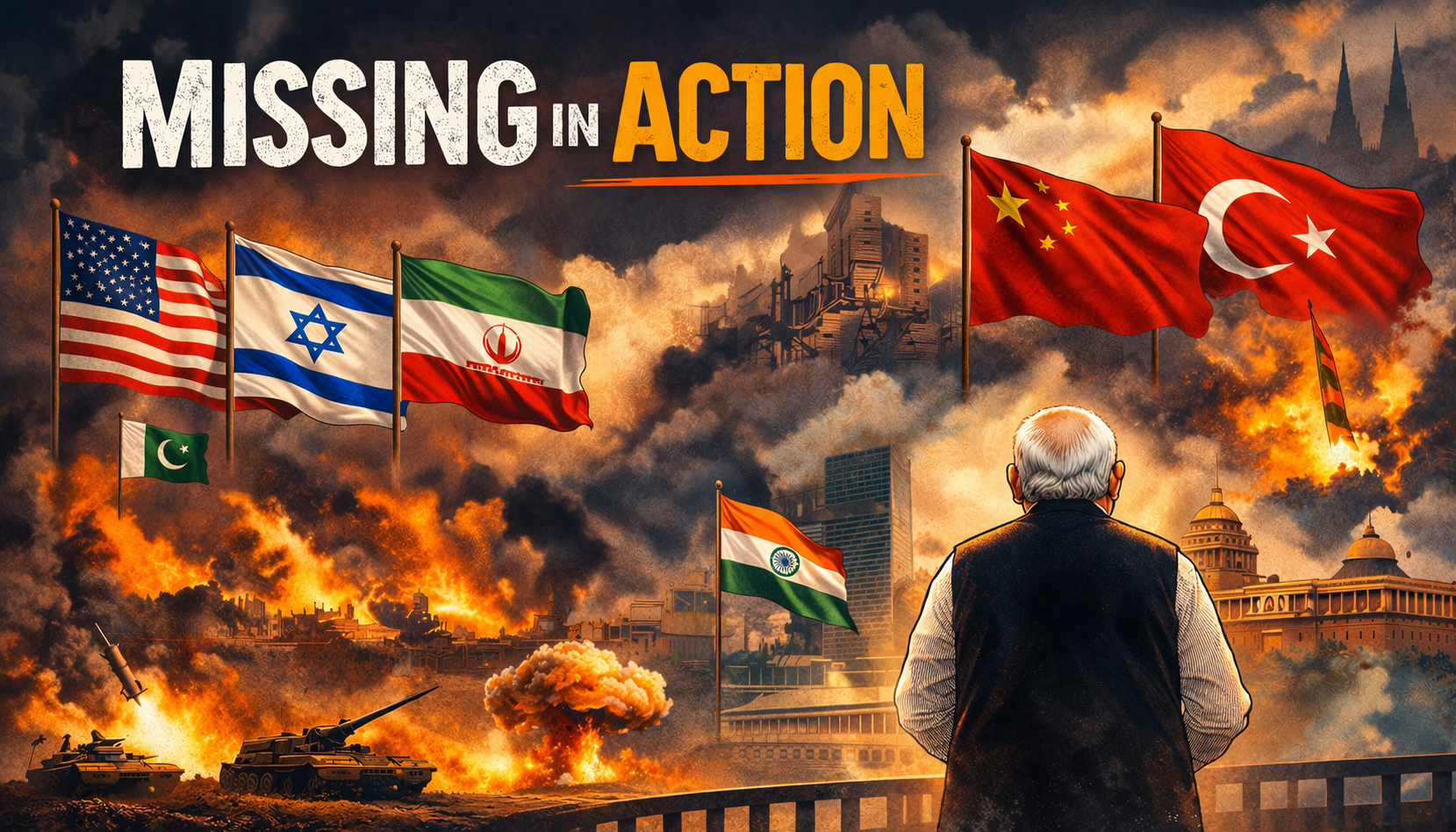
From Non-Alignment to No-Show, How India’s Lost the Global Narrative
The world has never been closer to the cusp of a nuclear flare-up than it has been over the last few weeks. This has also been a time when global leaders have come together, when their voices have been heard repeatedly across international news networks, when key players dominating the economic and political landscape have taken clear positions. Whether it is Russia and China backing Iran, or the British, French, Spanish and much of Europe calling out what they see as an ill-thought-through American and Israeli war on Iran and Lebanon, the world has been anything but silent.
There are also those who have seen this moment as an opportunity to make themselves relevant. Countries like Pakistan, Egypt, and Turkey have stepped in, made their positions clear, and used whatever influence they have over countries such as the United States and Iran to try and negotiate peace deals.
In all of these international players, if there is one conspicuously absent voice, it is India.
Historically, India has taken a position of non-alignment. This traces back to the formation of the Non-Aligned Movement in 1961, led by Jawaharlal Nehru, Gamal Abdel Nasser, and Sukarno. India was a founding member, and for decades positioned itself as a country that stayed above power blocs and ideological camps. But over the last few decades, as India has emerged as an economic power, it has been increasingly urged to take positions, not just political ones, but ethical and moral ones. Instead, we have made systematic blunders.
Whether it was campaigning for an American president during his first tenure under the “Howdy Modi” and “Namaste Trump” banners, or visiting Israel just days before the country attacked Iran and reinforcing India’s commitment to Israel, by extension aligning with what many see as an ill-thought through and illegal military action by the Americans and Israelis, India has slowly placed itself in a coterie that does not necessarily align with the idea and ethos of India. The US and Israel have indiscriminately attacked civilian areas, displaced more than a million people across Lebanon and Iran, and yet India’s positioning has lacked nuance, timing, and strategic foresight.
India’s absence from the international diplomatic scene, its ill-informed decisions, and more importantly, loose and defensive statements from its leadership, have only compounded the problem. Comments from the Foreign Minister such as “India is not a Dalal nation,” aimed at mocking Pakistan’s attempts at mediation, have only made India sound defensive. At a time when every country worth its salt is visible, audible, and opinionated, India appears to be missing from the conversation. The only rhetoric coming out of India, largely through media networks, is defensive mockery of Pakistan, a country that, ironically, is being seen as negotiating a peace deal.
This is where India, its government, and its extended media ecosystem, which is significantly influenced by it, have gotten it completely wrong. From that one comment from the External Affairs Minister all the way down to the media narrative ridiculing Pakistan’s negotiations, it shows a country that appears almost borderline jealous of Pakistan’s diplomatic positioning.
After Pakistan managed to secure a temporary ceasefire between Iran and the United States, global leaders congratulated Pakistan, its Prime Minister, and even its Field Marshal. Some went as far as suggesting them for a Nobel Peace Prize. As idiotic, hilarious, and atrocious as that sounds, and as much as the world knows that this so-called peace deal was orchestrated by the Americans as an off-ramp from a situation they had mishandled, Pakistan was still able to position itself as the face of that outcome. This even when the Pakistani Prime Minister embarrassingly copy-pasted a draft message from Washington and tweeted it with “draft for Pakistan PM” still visible, clearly exposing the fact that they were mere pawns, the narrative did not shift. Because in global politics, perception is reality and today, the perception is that Pakistan delivered peace.
Meanwhile, India, one of the fastest-growing economies in the world and a country that aspires to global influence, is absent. Completely absent. At a time when the world is closest to a nuclear confrontation, when leaders are speaking, negotiating, posturing, and shaping outcomes, India is simply not in the room. The irony is staggering. A country like Pakistan, often labelled globally as a sponsor of terror, is suddenly seen as a peace broker. And India, the land of Mahatma Gandhi, a nation that built its identity around non-violence, is nowhere in sight. Instead, the only news emerging from India is of the Prime Minister attending political rallies, focusing on regional elections, and defending his party’s position.
At a time when India could have leveraged its unique relationships with the United States, Israel, and Iran, with which it shares deep civilizational ties, it missed the opportunity to lead. This was India’s moment to step in as a credible negotiator. A natural bridge. A voice of reason. Instead, it did not even attempt to be in that space. And so we arrive at the current reality, where India’s Foreign Minister appears defensive, statements appear reactionary, and the country, diplomatically, looks like a headless chicken.
The larger question is, is this how far India’s foreign policy has drifted? Has arrogance replaced humility to the point where we believe we are globally relevant without actually doing the work required to be so? Are we now at a stage where our diplomacy is reduced to taking potshots at Pakistan while it dominates the narrative Because that is what this looks like.
India might be doing a lot behind the scenes. There may be back-channel negotiations, quiet interventions, subtle engagements. There is precedent for this, whether during the Taliban takeover of Afghanistan or other geopolitical flashpoints. But in today’s world, that is not enough. Visibility matters. Narrative matters. Timing matters. Leaders today communicate on social media faster than they brief their own press. Governments shape global perception in real time. India, on the other hand, continues to communicate in a manner that is far too conservative, far too old-fashioned, and far too slow.
And this is not new. Even during Operation Sindoor, when India decisively struck deep into Pakistan, targeting terrorist and military infrastructure close to critical command centres, the public narrative still tilted in Pakistan’s favour. Why? Because Pakistan understood communication. It understood speed. It understood narrative building. India did not. And it is the same story playing out again.
So while the world grapples with a potential global war, while countries negotiate, posture, and attempt to shape outcomes, India is seen as preoccupied with domestic politics. This disconnect is dangerous because global relevance is not claimed, it is demonstrated. And right now, India is not demonstrating it.
There needs to be a serious rethink. India needs to become proactive, visible, and strategically vocal. It needs to understand that timely, public interventions carry weight. That narrative is as important as action. Otherwise, it will continue to fall behind in global conversations that matter, slowly drifting into irrelevance at a time when it should be shaping the world order.