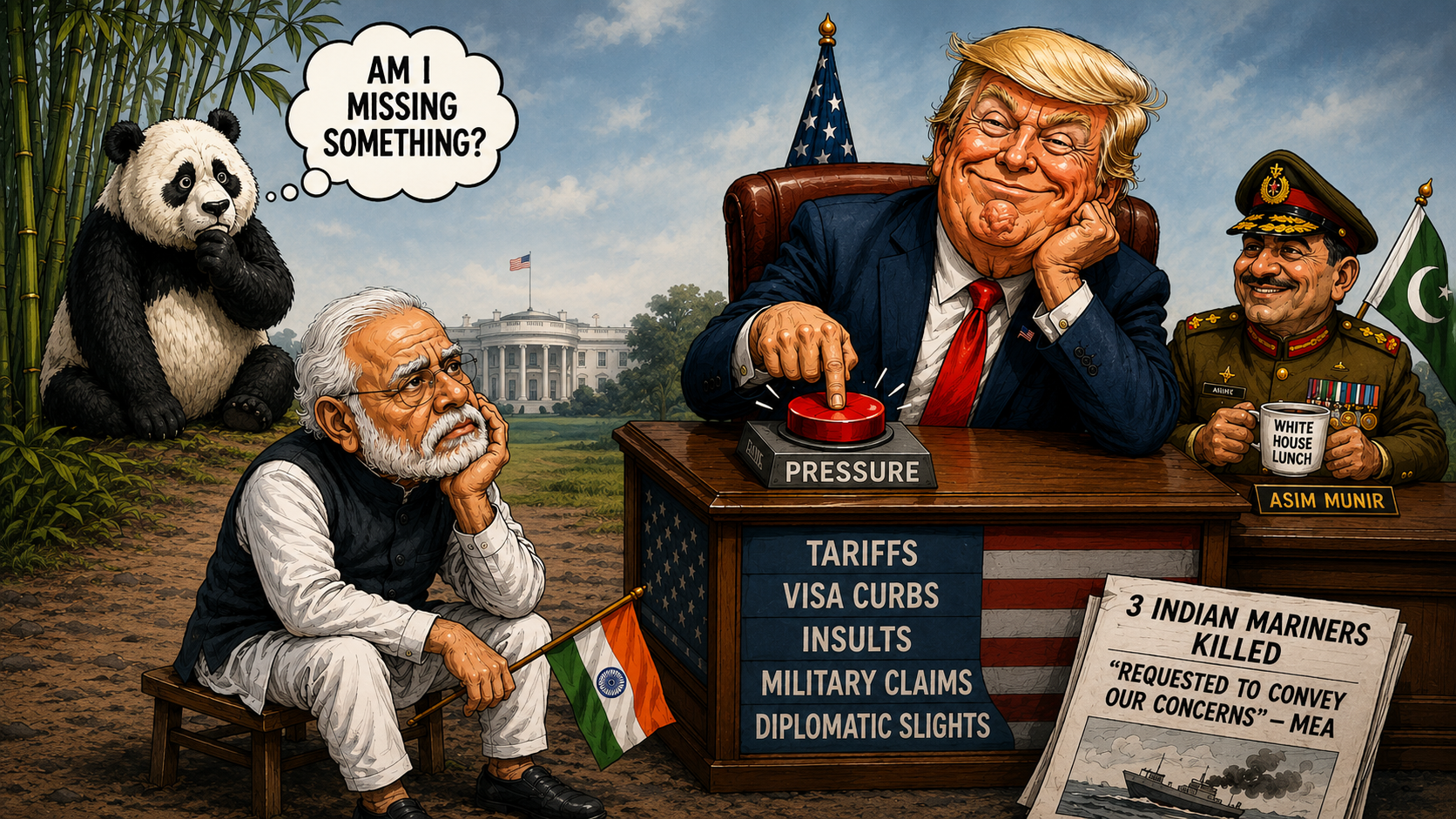
Indo-US Relations: Am I Missing Something?
The second term of President Donald Trump has been one during which India appears to have been institutionally and consistently snubbed by the United States. At least, that is the perception many Indians are beginning to form.
The first surprise came during Trump's swearing-in ceremony. Given the much-publicised chemistry between President Trump and Prime Minister Narendra Modi, many expected India to have a prominent presence. Instead, India was represented by External Affairs Minister S. Jaishankar. While leaders from several countries attended the inauguration, the absence of the Indian Prime Minister was noticeable and raised questions.
Then came a series of developments that many Indians viewed as systematic snubs.
First came the tariffs imposed on Indian goods. Then came the increasingly hostile discourse around H-1B visas, an issue that directly affects thousands of Indian professionals and families. Then came the "hell-hole" controversy, when President Trump shared on Truth Social comments by American commentator Michael Savage, who referred to people coming from "China, or India, or some other hell-hole on the planet." The comments triggered anger across India, with many asking how a country repeatedly described as a strategic partner could be spoken about in such terms.
Then came the biggest moment of all, Operation Sindoor.
On 10 May 2025, President Trump suddenly announced that the United States had helped secure a ceasefire between India and Pakistan. India's version was different. New Delhi maintained that Pakistan's Director General of Military Operations had contacted his Indian counterpart and that the understanding to stop military action had been reached through direct military channels between the two countries.
Yet India never appeared to challenge Trump's claim with the forcefulness many expected. Trump continued to publicly suggest that the United States had played a central role in securing the ceasefire. India's clarification came later and was much more measured. While India maintained its position, it never seemed to aggressively contest Trump's version of events. As a result, the global narrative increasingly became that Washington had brokered peace between two nuclear powers.
And the pattern appeared to continue.
When the "hell-hole" comments surfaced, Prime Minister Modi, who is otherwise highly active on social media and quick to comment on global events, remained publicly silent. This was despite widespread anger in India and an eruption of criticism across social media platforms.
Yet shortly afterwards, following the assassination attempt on President Trump, Prime Minister Modi was among the first global leaders to publicly express concern and wish him well. To many Indians, the contrast was difficult to ignore.
Then came the most recent controversy, the killing of three Indian mariners during US military action in the Gulf.
Again, the reaction from the Ministry of External Affairs was viewed by many as unusually restrained. This is surprising coming from a government that has built much of its image on strength, assertiveness and an unwillingness to remain silent in the face of perceived injustice. It is also surprising given that Foreign Minister S. Jaishankar has repeatedly argued around the world that India will pursue policies based solely on Indian interests and will not be pressured into changing course by external powers.
Yet when it comes to the Americans, many Indians believe the tone has been noticeably different.
The deaths of the three mariners immediately brought comparisons with two earlier episodes.
The first was the Italian Marines case. When two Italian marines were accused of killing Indian fishermen and Italy later attempted to prevent their return to India after they had been granted temporary leave, India reacted strongly. The Supreme Court even restrained Italian Ambassador Daniele Mancini from leaving India after Italy indicated the marines would not return. The episode triggered a major diplomatic confrontation and international debate over diplomatic immunity. Yet India stood its ground.
The second example was the Devyani Khobragade case. After the Indian diplomat was arrested and strip-searched in New York despite diplomatic protections, India reacted forcefully. Security barricades outside the US Embassy in New Delhi were removed overnight, privileges enjoyed by US diplomats were reviewed, and reciprocal action was taken against American diplomats, one of whom was made persona non-grata. It was a visible and unmistakable message to Washington.
This time, however, the response was different.
The Ministry of External Affairs summoned a US diplomat and said it had conveyed India's concerns. The language that drew attention was that India had requested that its concerns be communicated to the US authorities. For many observers, the word "requested" became the focus of the debate.
Shortly afterwards, Jaishankar posted on X: "Spoke to US Secretary of State Marco Rubio this evening. I reiterated India's strong protest at the attacks by the US Navy in the Gulf that killed three Indian mariners. Such lethal actions against commercial shipping are not justified."
The American version of the conversation sounded very different. According to the US readout, Rubio stressed that commercial vessels should comply with instructions issued by US forces and that violations relating to sanctions and the transport of Iranian oil would not be tolerated.
The contrast between the two accounts did not go unnoticed.
All of this raises a number of questions.
What exactly is happening?
Why does India appear so cautious when dealing with the United States?
Why does it seem that India is repeatedly on the receiving end of diplomatic pressure, criticism and embarrassment, yet continues to respond with restraint?
Why does a government that projects itself as strong and decisive appear reluctant to publicly challenge Washington?
And why does it seem that, soon after Operation Sindoor, President Trump hosted Pakistan's Field Marshal Asim Munir for a private lunch at the White House? Reuters described the meeting as unprecedented because no Pakistani army chief had previously been hosted in that manner without senior civilian Pakistani leadership being present.
For many Indians, the optics were terrible.
Here was Pakistan's Field Marshal receiving exceptional access to the President of the United States shortly after a military confrontation with India, while Trump continued to publicly claim credit for ending that conflict.
It is difficult to see why many Indians interpreted that as a diplomatic slight. And yet India continues to go out of its way to preserve and strengthen the relationship with the United States.
In today's world, perception matters. Perception is created by how nations communicate, how quickly they respond, and how effectively they shape narratives. At the moment, India appears to be losing that battle.
Now, there may well be a larger strategy at work. There may be calculations that are not visible to the public. There may be long-term economic, military or geopolitical considerations that justify restraint today in exchange for gains tomorrow.
That is for the government to explain. More importantly, it is for Indians to understand and believe. Because right now, the perception is that India is bending over backwards to preserve a relationship that appears increasingly unequal. The perception is that no matter how hard India tries to accommodate American interests, it remains on the receiving end of criticism, pressure and diplomatic embarrassment.
This creates another important question.
How does the government intend to manage that perception?
On one hand, Prime Minister Modi continues to project himself as one of India's strongest leaders, a leader who has elevated India's global profile and invested considerable political capital in building relationships around the world. On the other hand, when it comes to the United States, India has rarely appeared weaker. This becomes even more significant when viewed alongside India's evolving relationship with Russia.
Many Indians continue to believe that the India-Russia relationship has historically been built on trust, mutual respect and support during difficult moments. From Soviet backing during the 1971 war to decades of defence cooperation, the relationship has occupied a unique place in India's strategic thinking. Yet India now appears increasingly invested in a partnership with the United States, a country that many Indians believe has historically maintained closer ties with Pakistan and has often viewed South Asia through a very different lens.
As a result, the public perception is that India is gradually moving away from a trusted long-term partner and investing heavily in a relationship that often appears transactional and, at times, dismissive. Whether that perception is fair or unfair is open to debate. But perceptions matter. And if the government believes there is a larger game plan, it owes Indians an explanation. Otherwise, these questions will only grow louder.
Which brings me back to the question I started with.
Am I missing something?