Like It or Not, the World Owes Donald J. Trump a Thank You
At first glance, this headline may sound outrageous. It may even feel wrong. But if you stay with me for a few minutes, you might begin to see why Donald J. Trump may have unintentionally done the world a favour.
Here’s the context - the world has possibly not been this chaotic, this uncertain, or this much in turmoil as it has been over the last year or two, since Donald Trump came into power for the second time. Since taking over the presidency again, his attitude has been bullish. He has been aggressive. His posturing has been openly confrontational. He has spoken loosely with, and about, global leaders and countries, without any real sense of diplomacy or tact. He has been blunt. He has been curt. He has crossed almost every established line of diplomacy that world leaders have traditionally respected.
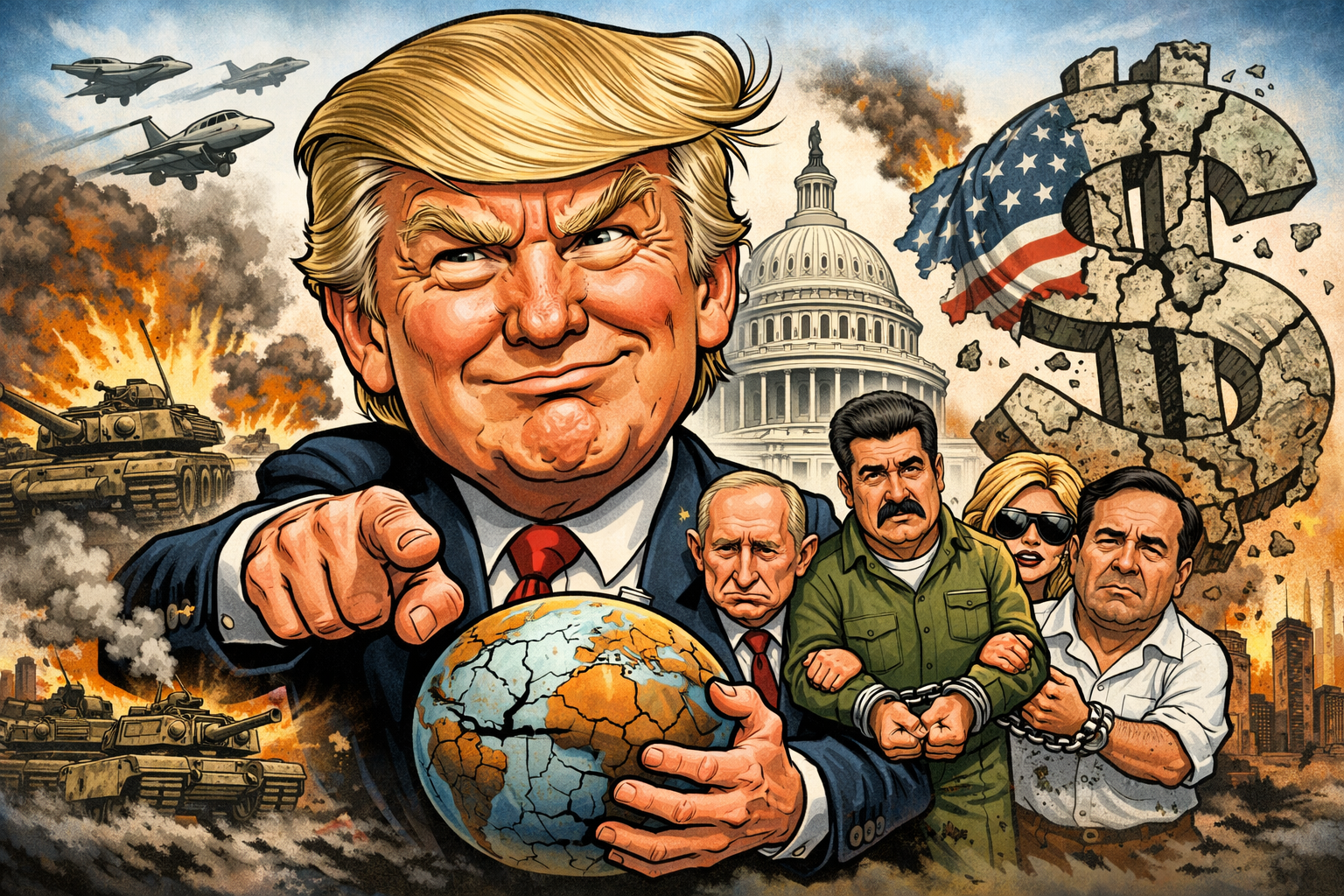
Over the last year or so, he has taken that even further. He has threatened countries openly. He has talked about taking over territories like Greenland. He has made aggressive statements about Cuba. He has even gone as far as sending in his military, picking up the Venezuelan leader along with his wife, flying them back to the United States, parading them in front of the media, and charging them like ordinary convicts. He has disrupted long-standing diplomatic norms that have governed how countries engage with each other.
Then came the economic shock.
By imposing extremely high tariffs, in some cases over 100 percent, on imports and exports, he effectively brought global commerce to a standstill. For decades, the world operated on a relatively stable system where countries were economically interdependent, supply chains were efficient, and trade relationships were predictable. Trump disrupted that completely. Countries were suddenly forced to either concede to his demands or face the consequences.
And then came the attack on Iran, which became the ultimate turning point, something that has significantly altered the global order.
So the question is, why should the world be thankful to Donald Trump?
Why should anyone be thankful to a leader who has created so much chaos, so much uncertainty, triggered conflicts, displaced people, and shaken entire regions?
Because what Donald Trump has actually done, perhaps unintentionally, is force a global reform of unimaginable proportions.
Through what many would call reckless or ill-thought-through actions, he has forced the world to confront realities it had long ignored. He has triggered a complete reordering of the global system.
The first and biggest impact is the collapse of what was almost a perfect marriage between Europe and the United States.
For decades, Europe was closely tied to the United States across trade, military cooperation, and broader geopolitical alignment. That relationship is now under strain like never before. Europe is being forced to rethink its dependencies and chart its own path.
This has opened the door to new bilateral trade relationships that would have been unthinkable earlier. The European Union is engaging more actively with emerging economies. Countries like the United Kingdom are expanding trade discussions with India and China. Across Europe, nations are beginning to prioritise their own economic interests more directly, rather than operating within a system heavily influenced by the United States.
The link with the so-called mothership, the United States, is weakening. And in that, new opportunities are emerging.
The second major shift is around security.
Europe’s long-standing dependence on the United States under the umbrella of NATO is now being questioned. The assumption that the United States will always provide security support is no longer taken for granted. This is forcing European nations to think seriously about building their own defence capabilities, either individually or collectively.
The third shift is in global relationships.
Europe now has the opportunity to reassess its relationship with countries like Russia and China. For years, these relationships were shaped by alignment with the United States. Today, Europe has the space to reconsider those dynamics, particularly in areas like energy and trade, which directly affect cost of living and economic stability.
Another major fallout is in the Far-West of Asia.
The region has begun to realise its own vulnerability. The presence of foreign military power, particularly from the United States, is now being seen not just as protection, but also as a risk. Countries in the region are being forced to rethink their positions and consider greater regional alignment for their own security.
And then comes what could be the biggest shift of all, the way global trade itself is conducted.
We are already beginning to see this shift in very real terms. Countries are no longer just talking about trading outside the US dollar, they are doing it.
China and Brazil have agreed to conduct trade directly in their own currencies, the yuan and the real. Russia and China have significantly increased trade in roubles and yuan, with a large portion of their trade now bypassing the dollar. India has signed local currency trade arrangements with multiple countries, including the UAE, Indonesia, Malaysia, and several African nations, to enable trade in rupees. Even regional blocs are moving in this direction, with parts of Africa now experimenting with systems that allow countries to trade directly in their own currencies without converting to dollars.
This is not theoretical anymore. This is happening. And what this means is profound.
For decades, the US dollar has been the backbone of global trade. Countries traded in dollars, held reserves in dollars, and depended on dollar-based systems like SWIFT to move money across borders. That system gave the United States enormous power, economic, political, and strategic.
But when countries begin to trade in their own currencies, that dependence starts to weaken.
The demand for the US dollar in global trade begins to reduce. Countries no longer need to hold as many dollar reserves. The ability of the United States to influence global trade through financial systems, sanctions, and currency dominance starts to erode.
This does not mean the dollar will collapse. It is far too deeply embedded for that.
But what it does mean is that the world is slowly moving away from a system where the US dollar was the unquestioned centre of global commerce.
Trade is becoming more decentralised. More regional. More bilateral. Instead of one dominant system, multiple systems are beginning to emerge.
Groupings like BRICS are pushing for greater use of local currencies. Countries are building parallel financial channels. Regional cooperation is increasing. South-South trade is gaining momentum. The global economic order is no longer singular. It is becoming fragmented, and in that fragmentation lies a redistribution of power.
What we are witnessing is the early stage of a new global order. And here is the uncomfortable truth. None of this would have happened at this pace if the United States had a more conventional, measured, and predictable leader. The world needed disruption to force change. It needed someone willing to break norms, to shake systems, and to accelerate decisions that had been delayed for decades.
Donald Trump, through his actions, has done exactly that.
The change may be messy. It may be uncomfortable. It may even be dangerous in parts but it is real and it is happening.
So, while the world may criticise him, question him, and even fear the consequences of his decisions, it may one day have to accept that this global reset was not driven by vision or intent, but is in fact a fallout of his own excesses, his megalomaniac instincts, and his deeply flawed decisions, where something larger and unintended has come out of actions that were anything but thoughtful.
For that reason alone, the world may have to, reluctantly, thank Donald J. Trump.