We Locked the Door and Let the Stranger In
Something quite extraordinary is happening in America right now. Some of the world's biggest social media companies are being forced to answer a fairly simple question: did they build products that were designed to keep children coming back, even when there were concerns about the harm they might cause?
This week, a landmark federal trial began in California involving Meta, the company behind Facebook and Instagram. A coalition of 29 US states has accused Meta of designing its platforms in ways that make them addictive to children, misleading the public about their safety and improperly collecting children's data. Meta strongly denies the allegations and says it has invested heavily in protecting young users. Reuters describes it as perhaps the most significant legal test yet of social media's impact on young people.
And this is hardly one isolated court case.
Meta, Google's YouTube, TikTok and Snap are facing thousands of cases in the United States alleging that their platforms were deliberately designed to capture young people's attention and contributed to mental-health harms. In March this year, a Los Angeles jury found Meta and Google negligent in one such case and awarded $6 million to a young woman who said she became addicted to Instagram and YouTube as a child. TikTok and Snap had settled with her before the trial. TikTok has since agreed to settle several more cases brought by young people. The companies continue to contest the wider allegations against them. Reuters has been tracking the litigation here.
It feels remarkably similar to a debate society has had before. For years cigarettes were simply part of life. They were everywhere. They were advertised brilliantly. They were enormously profitable. We accepted the product long before we fully understood, or were prepared to confront, what it was doing to us.
Then came the evidence. Then the court cases. Then regulation.
Perhaps social media is approaching its cigarette moment. Not because scrolling through Instagram is medically the same as smoking a cigarette. It isn't. But because once again we have normalised a hugely profitable product, allowed an entire generation to consume it, and only now begun seriously asking what it may be doing to them.
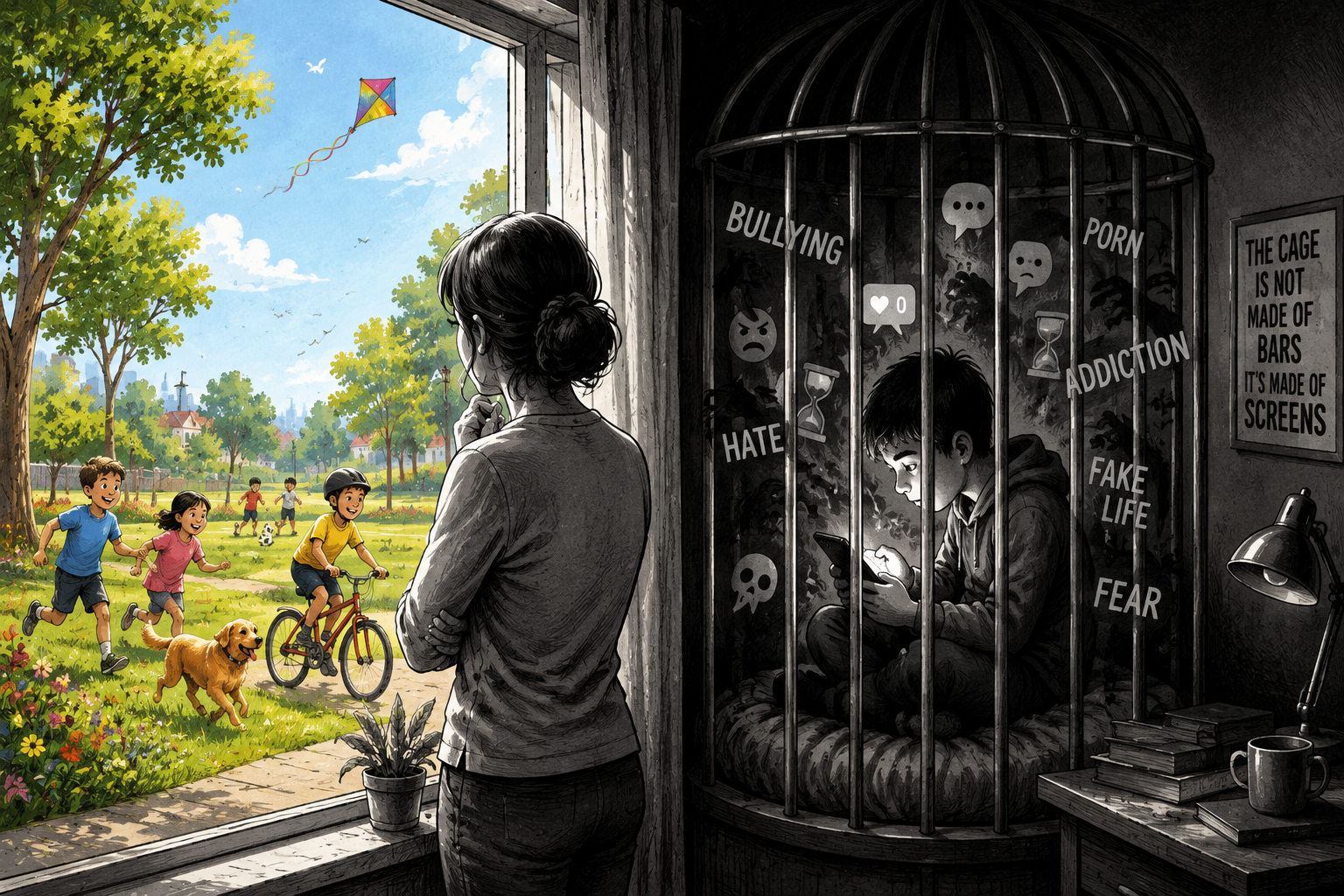
And nowhere is the contradiction greater than in the way we raise our children. A child playing at the end of the street makes us nervous. A child walking to a friend's house may be tracked on a phone. We have doorbell cameras, GPS trackers, family-location apps and repeated messages asking: Where are you? Who are you with? When are you coming home? Yet that same child can sit alone in a bedroom for hours, phone in hand, moving between TikTok, Instagram, Snapchat, YouTube, gaming platforms and group chats, and somehow we feel better.
At least they are home. We fear the street we can see, but trust the screen we cannot.
A few generations ago, childhood was much more outdoors. Children played in streets and parks, rode bicycles, climbed trees, fought with friends, made up again, scraped their knees, got filthy and came home when they were hungry. Nobody should romanticise the past. It wasn't perfectly safe. Children were abused, assaulted and exploited then too, and much of it was poorly understood or never reported. But our perception of danger has changed far more dramatically than the danger itself.
Look at the broader picture. The latest Office for National Statistics figures show that violence in England and Wales remains dramatically below its peak in the mid-1990s. Police recorded 499 homicides in the year ending March 2026, down 7 per cent from the previous year.
And look at the fear that probably sits deepest in the minds of many parents: the stranger waiting for a child outside. The latest detailed ONS homicide analysis recorded 59 homicide victims under the age of 16 in England and Wales in the year ending March 2025. Eight were killed by a stranger. Where the relationship with a suspect was known, a parent or step-parent was the most common category. The overall homicide rate that year was the lowest recorded since 1977.
That does not mean the street is completely safe. Of course it isn't. It means the thing we fear most is not necessarily the thing most likely to harm a child. Perhaps nowhere is that more important than when we talk about paedophiles. For generations, parents have been taught to fear the unknown man in the park, the stranger hanging around the school gate or somebody approaching a child walking home alone.
That fear is understandable. Child sexual abuse is real and horrific. But the evidence paints a rather different picture from the one many of us carry in our heads. When physical sexual abuse takes place, the perpetrator is overwhelmingly more likely to be somebody already known to the child than the mysterious stranger lurking outside.
And when strangers do want access to children today, they no longer need to wait in parks. They have the internet.
In 2024, police in England and Wales recorded 122,768 child sexual abuse and exploitation offences. At least 42 per cent had an online footprint. Online-related offences increased by 26 per cent in a single year. That is not a marginal part of the problem anymore. It is tens of thousands of cases. The figures come from the national analysis of police-recorded child sexual abuse and exploitation.
So perhaps our idea of "stranger danger" needs updating. The stranger no longer needs to sit on a park bench watching children. He can be hundreds of miles away. He can pretend to be 13. He can know what music your daughter likes, what football team your son supports, who their friends are and what they did at school that day. He can spend days or weeks building trust before a parent even knows he exists.
And he can do all of this while the child is exactly where the parent believes he or she is safest. At home.
That is the extraordinary contradiction. We have spent years making the physical world around our children smaller because we are frightened of who might approach them. Then we gave them a device through which almost anybody in the world can knock on the door. And children are spending an extraordinary amount of time behind that door.
Ofcom's latest research found that children aged 8 to 14 spend an average of 3 hours and 36 minutes online every day across smartphones, tablets and computers. That is more than 25 hours every week. Among 15-to-17-year-olds it rises to more than 44 hours a week. Nearly three-quarters of 11-to-17-year-olds told Ofcom they had encountered potentially harmful content online. Among young people who game online, 55 per cent said they at least sometimes interact with people they have only ever met online. And 84 per cent of children aged 8 to 12 are using at least one of the five biggest online services despite those services generally having a minimum age of 13.
Think about that for a moment. We may hesitate to allow a ten-year-old to walk to the shops because we don't know who they might meet. Then we give that same ten-year-old a device through which almost anyone, anywhere in the world, can potentially reach them. A GPS tracker can tell us our daughter is sitting safely in her bedroom. It cannot tell us who is messaging her. A camera can tell us our son arrived home from school at 4.15. It cannot tell us what an algorithm is showing him at midnight. And perhaps the same technology is partly responsible for making us so frightened of the world outside in the first place.
Twenty-five years ago, a horrific crime against a child three hundred miles away might have appeared once on the evening news. Today we see the breaking-news alert. Then the Facebook post. Then somebody forwards it on WhatsApp. Then comes a video. Then another parent shares it. Then an algorithm notices that we stopped to look at it and gives us another frightening story.
Geography disappears. A crime in another city starts to feel as though it happened around the corner. The exceptional starts to feel normal. Nobody sends us a breaking-news notification saying: Millions of children went outside today, played, got dirty and came home safely.
Parents should not be blamed for this. Modern life is exhausting. People work long hours. Parents themselves live on their phones. A child quietly occupied by a screen gives a mother or father twenty minutes to cook dinner, answer emails, finish some work, speak to each other or simply sit down. Every parent understands that temptation. But parents are competing with some of the richest and most sophisticated technology companies on earth, and those companies have enormous commercial incentives to keep people looking at their screens.
Which brings us back to those courtrooms in America. Whether the states ultimately prove all their allegations against Meta is for the courts to decide. Meta denies deliberately creating harmful products. But surely the wider question cannot be left to courts alone. Why have we allowed social media to become almost completely free at the point of use?
Because it isn't actually free. We pay the price with attention, data and time. The genius of the business model is that somebody else pays the financial bill while we provide what the platforms really want. Our attention. So perhaps it is time to change the bargain. Charge for social media. All of it. Facebook. Instagram. TikTok. Snapchat. X. Whatever comes next. Put a price on having an account.
It doesn't have to be enormous. A modest monthly or annual charge would be enough to introduce something social media currently lacks almost completely: friction. Imagine paying to maintain four social-media accounts. Imagine paying every month simply to scroll through TikTok. Imagine a parent having to decide whether an Instagram account for a 13-year-old is actually worth purchasing. Would social media disappear?
Of course not. Would people think twice about how many platforms they joined and how much they used them? I suspect they would.
We pay for Netflix. We pay for cinema. We pay for newspapers. We pay for games. We pay for almost every other commercial entertainment product we consume. Why should unlimited access to some of the most sophisticated attention-capturing products ever invented be available without the user paying anything? There would obviously have to be protections. Nobody should have to pay to access government information, emergency services, education or essential communication. Digital participation cannot become the privilege of people who have money.
But social media is not a public utility. It is a commercial product. Treat it like one.
Governments are beginning to intervene. Britain has introduced legal child-safety obligations through the Online Safety Act. Australia has gone further by requiring age-restricted social-media platforms to take reasonable steps to prevent under-16s from holding accounts. But age restrictions alone are not enough. We need to look at the entire model: endless scrolling, autoplay, notifications, streaks, recommendation engines and every other little mechanism whose job is to persuade someone that perhaps one more minute online won't hurt.
And while governments work that out, perhaps we as parents need to rethink what childhood itself should look like.
Teach children about danger. Teach them boundaries. Know where younger children are. But let them play. Let them walk. Let them climb trees. Let them get dirty. Let them get bored. Let them argue with friends without an adult immediately intervening. Let them fall occasionally and discover that they can stand up again. And bring the same vigilance we have applied to the street, the playground and the journey home from school into the digital spaces where children now spend such an extraordinary part of their lives.
Because we have spent a generation teaching children not to talk to strangers in the street. Then we handed them a device through which strangers, predators, algorithms and advertisers can reach them in their bedrooms. Perhaps the most dangerous thing we did was convince ourselves that because they were home, they were safe.